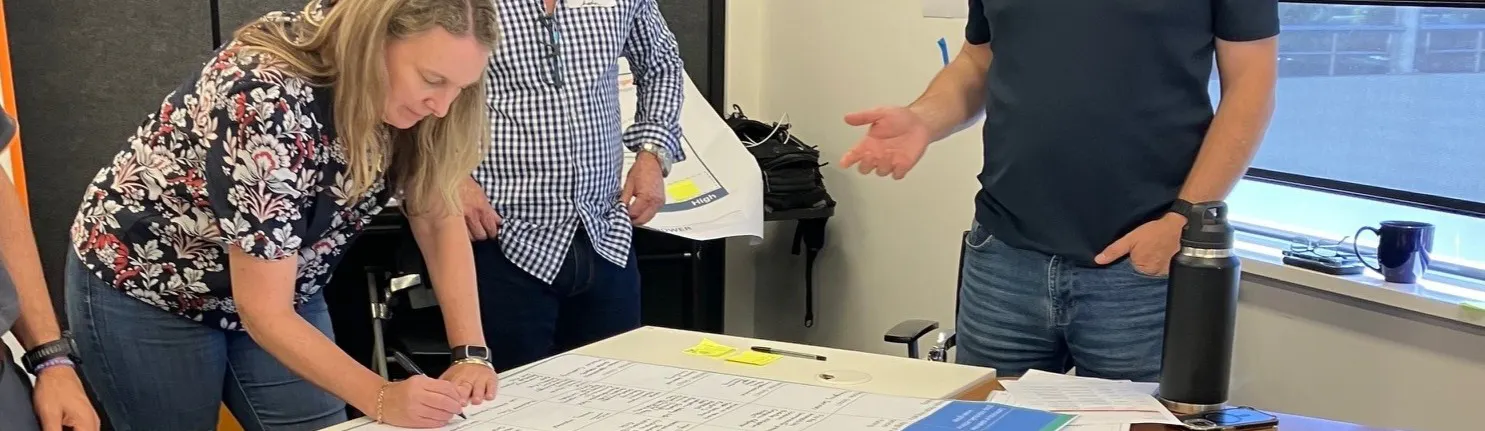
Stakeholder Engagement Resource Hub
Essential Energy's Stakeholder Engagement Resource Hub is a 'one stop shop' where employees can find Essential Energy's Stakeholder Engagement Framework and supporting tools, templates and useful information to support your engagement activities.
Essential Energy's Stakeholder Engagement Framework (SEF) is regularly refreshed to reflect feedback through consultation, research, changing dynamics of stakeholders and projects and emerging trends and innovation in engagement practices.

Stakeholder Engagement Support
Implementation of the Stakeholder Engagement Framework is supported by guidance from the stakeholder engagement team. Reach out if you would like a helping hand in developing your engagement plan for your project or to discuss ‘engaging’ ideas.
We have created this internal Stakeholder Engagement Resource Hub (Hub) to share templates, tools, reference documents and case studies. This Hub is also a place for employees to share ideas, talk about the different engagement methods and tools being considered, and connect with others working on stakeholder engagement activities.
Our team of Community Relations Managers (CRMs) understand our communities and have trusted relationships with stakeholders in these communities. Get in touch with the CRM before project initiation, to ensure you have the background information and accurate community insights.
The Customer Research team provides customer research & insight support to the business, and if you are thinking about conducting some research then please get in touch. Having visibility of the customer studies taking place across the business allows all of us to be mindful of our impact on customers, and to collaborate and share insight where relevant.
Have you met our First Nations engagement advisors? They are here to provide subject matter expertise to support the business to deliver safe, effective, and culturally sensitive engagement with First Nations peoples and communities. The team also leads the planning, co-ordination and reporting of First Nations engagement activities across the Essential Energy footprint.
Our Stakeholder Engagement Framework is informed by IAP2, an Association that promotes public participation and engagement in decision-making. Essential Energy is a member of IAP2, and as a member you can sign up to receive correspondence from IAP2 and access to online resources. Contact the Stakeholder Engagement team to connect.
| IAP2 SPECTRUM OF PUBLIC PARTICIPATION | ||||
| INFORM | CONSULT | INVOLVE | COLLABORATE | EMPOWER |
Goal | To provide the public with balanced and objective information to assist them in understanding the problem, alternatives, opportunities and/or solutions. | To obtain public feedback on analysis, alternatives and/or decisions. | To work directly with the public throughout the process to ensure that public concerns and aspirations are consistently understood and considered. | To partner with the public in each aspect of the decision including the development of alternatives and the identification of the preferred solution. | To place final decision making in the hands of the public. |
Promise | “We will keep you informed.” | “We will keep you informed, listen and acknowledge concerns and aspirations, and provide feedback on how public input influenced the decision.” | “We will work with you to ensure that your concerns and aspirations are directly reflected in the alternatives developed and provide feedback on how public input influenced the decision.” | “We will look to you for advice and innovation in formulating solutions and incorporate your advice and recommendations into the decisions to the maximum extent possible.” | “We will implement what you decide.” |
Engagement techniques | Examples: factsheets, newsletters, website Consider: Accessible language, First Nations and CALD | Examples: surveys, meetings Required: Pre-reading material e.g. Discussion paper or video | Examples: workshops, advisory groups, deep dives Required: Executive and decision-maker participation. Translate complex docs into plain and easy language or animations | Examples: Deliberative forum, co-design workshop or People’s Panel, Digital Democracy – using Essential Engagement Required: Skilled facilitator | Examples: Citizen’s juries, independently governed reference groups Required: Extensive resource commitment for internal and external stakeholders |
Essential Energy's Stakeholder Engagement Resource Hub is a 'one stop shop' where employees can find Essential Energy's Stakeholder Engagement Framework and supporting tools, templates and useful information to support your engagement activities.
Essential Energy's Stakeholder Engagement Framework (SEF) is regularly refreshed to reflect feedback through consultation, research, changing dynamics of stakeholders and projects and emerging trends and innovation in engagement practices.
Stakeholder Engagement Support
Implementation of the Stakeholder Engagement Framework is supported by guidance from the stakeholder engagement team. Reach out if you would like a helping hand in developing your engagement plan for your project or to discuss ‘engaging’ ideas.
We have created this internal Stakeholder Engagement Resource Hub (Hub) to share templates, tools, reference documents and case studies. This Hub is also a place for employees to share ideas, talk about the different engagement methods and tools being considered, and connect with others working on stakeholder engagement activities.
Our team of Community Relations Managers (CRMs) understand our communities and have trusted relationships with stakeholders in these communities. Get in touch with the CRM before project initiation, to ensure you have the background information and accurate community insights.
The Customer Research team provides customer research & insight support to the business, and if you are thinking about conducting some research then please get in touch. Having visibility of the customer studies taking place across the business allows all of us to be mindful of our impact on customers, and to collaborate and share insight where relevant.
Have you met our First Nations engagement advisors? They are here to provide subject matter expertise to support the business to deliver safe, effective, and culturally sensitive engagement with First Nations peoples and communities. The team also leads the planning, co-ordination and reporting of First Nations engagement activities across the Essential Energy footprint.
Our Stakeholder Engagement Framework is informed by IAP2, an Association that promotes public participation and engagement in decision-making. Essential Energy is a member of IAP2, and as a member you can sign up to receive correspondence from IAP2 and access to online resources. Contact the Stakeholder Engagement team to connect.
| IAP2 SPECTRUM OF PUBLIC PARTICIPATION | ||||
| INFORM | CONSULT | INVOLVE | COLLABORATE | EMPOWER |
Goal | To provide the public with balanced and objective information to assist them in understanding the problem, alternatives, opportunities and/or solutions. | To obtain public feedback on analysis, alternatives and/or decisions. | To work directly with the public throughout the process to ensure that public concerns and aspirations are consistently understood and considered. | To partner with the public in each aspect of the decision including the development of alternatives and the identification of the preferred solution. | To place final decision making in the hands of the public. |
Promise | “We will keep you informed.” | “We will keep you informed, listen and acknowledge concerns and aspirations, and provide feedback on how public input influenced the decision.” | “We will work with you to ensure that your concerns and aspirations are directly reflected in the alternatives developed and provide feedback on how public input influenced the decision.” | “We will look to you for advice and innovation in formulating solutions and incorporate your advice and recommendations into the decisions to the maximum extent possible.” | “We will implement what you decide.” |
Engagement techniques | Examples: factsheets, newsletters, website Consider: Accessible language, First Nations and CALD | Examples: surveys, meetings Required: Pre-reading material e.g. Discussion paper or video | Examples: workshops, advisory groups, deep dives Required: Executive and decision-maker participation. Translate complex docs into plain and easy language or animations | Examples: Deliberative forum, co-design workshop or People’s Panel, Digital Democracy – using Essential Engagement Required: Skilled facilitator | Examples: Citizen’s juries, independently governed reference groups Required: Extensive resource commitment for internal and external stakeholders |
-
Why engage with our customers and communities?
about 2 years agoShare Why engage with our customers and communities? on Facebook Share Why engage with our customers and communities? on Twitter Share Why engage with our customers and communities? on Linkedin Email Why engage with our customers and communities? link
An initiative of The Energy Charter Better Together Know Your Customers and Communities1. Why do we listen to customers?
All energy businesses are here to serve our customers and communities. Put simply, without customers (whether they are residential, small & medium business, or large commercial & industrial) we would not have our business. To deliver our energy products and services in a way that meets our customer and community needs and expectations, we first need to understand: what are those needs and expectations?
That’s why engaging with our customers, consumers and communities is essential.
2. What’s this got to do with me?
Maybe you’re a network engineer, a planner or a marketing manager and you’re thinking, what’s this got to do with me? It’s easy to think that engaging with customers and communities is the job of those in our business who interact with them every day. Maybe you’ve even got a dedicated team of Stakeholder Relations or Community Relations folk.
Well, the good news is that the more people in our business that speak to our customers and communities, the better we will be. If you haven’t yet had the opportunity to genuinely engage with our customers and community you will be surprised at what a rewarding experience it can be, and how it may help you do your job better!
That’s because speaking to customers and communities gives us all the opportunity to understand:
- Who is using our energy products and services and who else might benefit from them?
- Why are they using them and how and where they are being used?
- How can our energy products and services be improved?
- Do our energy products and services meet future needs and expectations?
- How is a community impacted by our activities and is there shared value for all?
3. Supporting you
There are people in our organisation that can share opportunities to engage with our customers and communities and support you in doing so. There’s also a Stakeholder Engagement Framework that can give you some tips.
We’d encourage you to contact the following people if you want more information:
Karyn Looby, Stakeholder Engagement Specialist
4. Finally… share the feedback!
Remember to share the insights across your organisation!
Often people are being asked similar questions from different people across our organisation, or information gained from a conversation in one area of our organisation can benefit someone else in another area.
An initiative of The Energy Charter Better Together Know Your Customers and Communities1. Why do we listen to customers?
All energy businesses are here to serve our customers and communities. Put simply, without customers (whether they are residential, small & medium business, or large commercial & industrial) we would not have our business. To deliver our energy products and services in a way that meets our customer and community needs and expectations, we first need to understand: what are those needs and expectations?
That’s why engaging with our customers, consumers and communities is essential.
2. What’s this got to do with me?
Maybe you’re a network engineer, a planner or a marketing manager and you’re thinking, what’s this got to do with me? It’s easy to think that engaging with customers and communities is the job of those in our business who interact with them every day. Maybe you’ve even got a dedicated team of Stakeholder Relations or Community Relations folk.
Well, the good news is that the more people in our business that speak to our customers and communities, the better we will be. If you haven’t yet had the opportunity to genuinely engage with our customers and community you will be surprised at what a rewarding experience it can be, and how it may help you do your job better!
That’s because speaking to customers and communities gives us all the opportunity to understand:
- Who is using our energy products and services and who else might benefit from them?
- Why are they using them and how and where they are being used?
- How can our energy products and services be improved?
- Do our energy products and services meet future needs and expectations?
- How is a community impacted by our activities and is there shared value for all?
3. Supporting you
There are people in our organisation that can share opportunities to engage with our customers and communities and support you in doing so. There’s also a Stakeholder Engagement Framework that can give you some tips.
We’d encourage you to contact the following people if you want more information:
Karyn Looby, Stakeholder Engagement Specialist
4. Finally… share the feedback!
Remember to share the insights across your organisation!
Often people are being asked similar questions from different people across our organisation, or information gained from a conversation in one area of our organisation can benefit someone else in another area.

Go to discussion -
First Nations Engagement
over 2 years agoShare First Nations Engagement on Facebook Share First Nations Engagement on Twitter Share First Nations Engagement on Linkedin Email First Nations Engagement linkTen principles when undertaking engagement with First Nations communities (IAP2)
- Start well – At the start of an engagement activity, always share an Acknowledgement, Welcome or Statement of Country. Make it meaningful to people in the room, Country and project.
- Early engagement - Approach First Nations communities at the earliest project planning stage.
- Recognise diversity - Seek out diversity within the First Nations communities. Meet with groups individually.
- Be mindful of language – Use respectful and inclusive language. This includes using English terms that may be culturally insensitive for some.
- Cultural load – Be aware of the cultural load on First Nation team members. They carry more community expectations than others.
- Appropriate tools - Select your techniques wisely, use the telephone, host small meetings, and carefully consider locations.
- Relevance – Not all engagement will be relevant to all First Nations groups. Accept that some individuals or groups may not want to participate.
- Build relationships – Approach as an ongoing relationship, not a transactional or project-by-project approach.
- Time – Recognise that First Nations engagement takes time and build this into your program.
- Openness – Create an openness and opportunity to share in the engagement. This may include things that are not directly related to your topic or project.
Ten principles when undertaking engagement with First Nations communities (IAP2)
- Start well – At the start of an engagement activity, always share an Acknowledgement, Welcome or Statement of Country. Make it meaningful to people in the room, Country and project.
- Early engagement - Approach First Nations communities at the earliest project planning stage.
- Recognise diversity - Seek out diversity within the First Nations communities. Meet with groups individually.
- Be mindful of language – Use respectful and inclusive language. This includes using English terms that may be culturally insensitive for some.
- Cultural load – Be aware of the cultural load on First Nation team members. They carry more community expectations than others.
- Appropriate tools - Select your techniques wisely, use the telephone, host small meetings, and carefully consider locations.
- Relevance – Not all engagement will be relevant to all First Nations groups. Accept that some individuals or groups may not want to participate.
- Build relationships – Approach as an ongoing relationship, not a transactional or project-by-project approach.
- Time – Recognise that First Nations engagement takes time and build this into your program.
- Openness – Create an openness and opportunity to share in the engagement. This may include things that are not directly related to your topic or project.
-
IAP2 framework
over 2 years agoShare IAP2 framework on Facebook Share IAP2 framework on Twitter Share IAP2 framework on Linkedin Email IAP2 framework linkEngagement is not a substitute word for consultation. IAP2 have developed a flexible framework - the IAP2 Spectrum, that explains the different levels of engagement that we can use to engage our customers, stakeholders and community.
An engagement colleague Max Hardy has shared his reflections on the IAP2 Spectrum:
What is it?
It is a framework that explains the different levels of engagement that organisations can engage their stakeholders/communities. The further to the right on the Spectrum, the greater the influence the community has to influence decision-making. At each level a different promise to the community applies – aContinue reading
Engagement is not a substitute word for consultation. IAP2 have developed a flexible framework - the IAP2 Spectrum, that explains the different levels of engagement that we can use to engage our customers, stakeholders and community.
An engagement colleague Max Hardy has shared his reflections on the IAP2 Spectrum:
What is it?
It is a framework that explains the different levels of engagement that organisations can engage their stakeholders/communities. The further to the right on the Spectrum, the greater the influence the community has to influence decision-making. At each level a different promise to the community applies – a promise that decision-makers can be held accountable to. Each level requires a different type of interaction.
The Inform level simply offers to provide information throughout a process about work being undertaken by an internal or expert team leading up to a decision being made. The promise is simply keeping people informed – some would say it is about helping people to understand. No input or feedback is sought from the community of interest.
The Consult level is about putting forward options or a proposal for which feedback is sought. The promise is to listen to the community of interest’s feedback, to carefully consider, then make decisions and finally explain how this feedback has been taken into account.
The Involve level invites input and ideas from the community to help develop options/potential solutions. The community participates earlier in the process than for the consult level. The community is part of developing solutions, not merely commenting about plans or solutions being proposed by an organisation. Ultimately the organisation will still make decisions, but they promise that the decisions will be informed by ideas and input.
The Collaborate level is a significant jump. It’s about partnering and sharing power – to the maximum extent possible (a phrase that has been used, confused and misused). It takes more time and effort. A range of stakeholders/community members work together with the sponsoring organisation to define the scope of the decision to be made, to develop options, to assess those options against agreed criteria in an attempt to arrive at consensus. Although more time consuming and expensive it is the shortest route to an implementable solution for highly complex/controversial decisions.
The Empower level is essentially delegated decision-making. It is where an organisation promises to do whatever the ‘community of interest’ decides.
Some common misunderstandings of the Spectrum
1. You start at the left and go right. Some have misunderstood the framework completely, thinking that you start off Informing, then you Consult, then you Involve etc. It’s a framework and a not a process guide.
2. At the Inform level a decision has already been made (like the DAD approach; Decide Announce and Defend). It may seem like a subtle difference but this is not the case. At the Inform level the public is kept informed about progress being made by an internal working group, until a decision is made. No input or feedback is sough – people are just progressively informed about what is going on.
3. Once a level is selected that is what you have to do throughout. This is not necessarily the case. IAP2 does not actually stipulate this, but those trained in the IAP2 Certificate are told that it is very important to work out the highest level on the Spectrum you will go for any given process. All the levels to the left of that level also apply.
4. The further to the right on the Spectrum the better it is. This was never the intention and it is why the Spectrum runs left to right – so that it does not appear to be a hierarchy like Arnstein’s Ladder. IAP2 has attempted to convey through the training, that it depends. It is about finding the most appropriate level. Trying to Collaborate on something fairly straightforward, where there is little passion or complexity, would be a waste of time. Doing a simple Consult level process for something highly complex will probably result in having to start all over again, after having done some damage.
5. It is up to the organisation to decide what level, and be clear about it, then everything should run smoothly. In my experience this is nonsense. The level often needs to be negotiated, and communities have shown that they can challenge the level of engagement, especially when particular stakeholder groups have been overlooked in the process.
Happy to chat about how you may use the Spectrum in your engagement program. Karyn - 0429 040 951 -
Local engagement in Ivanhoe to get to know customers better and learn how best to communicate with the community throughout the course of the project
over 2 years agoShare Local engagement in Ivanhoe to get to know customers better and learn how best to communicate with the community throughout the course of the project on Facebook Share Local engagement in Ivanhoe to get to know customers better and learn how best to communicate with the community throughout the course of the project on Twitter Share Local engagement in Ivanhoe to get to know customers better and learn how best to communicate with the community throughout the course of the project on Linkedin Email Local engagement in Ivanhoe to get to know customers better and learn how best to communicate with the community throughout the course of the project linkThe Smart Energy Community team went on a road trip to meet some of our customers in Ivanhoe - one of the communities involved in the trial.
Manager of Innovation, Brad Trethewey and Smart Energy Communities (SEC) Program Manager, Theresa French along with Stage One partners Wattwatchers spent the week of Monday 28 August getting to know the community and listening to our customers about their energy concerns.
Ivanhoe is currently in Stage One of the trial, so the purpose of the trip was to formally introduce the SEC program to the town, to get a better understanding of the community as a whole and to start a conversation about the trial.
Murray and Tim from Wattwatchers joined Theresa French and Brad Trethewey for the visit. A meet-and-greet style event was set up at the Ivanhoe RSL, giving the team a chance to meet members of the entire community - complete with beautiful cupcakes made from the local CWA group. Brad and Theresa also took to the footpath for a bit of a walk around the town, meeting people along the way. Being a remote town, without a depot, this was an excellent opportunity to get to know our customers a little better and to learn how best to communicate with the community throughout the course of the project.
The team was warmly welcomed and had valuable conversations about the challenges a small community like this faces, especially regarding their power usage and unplanned outages being a fringe of grid community at the end of a long electricity line.
Brad Trethewey, Luke Clarke, Jack Storrier and Theresa French at the meet-and-greet event. Jack Storrier from Hillston depot and Luke Clarke from the Hay Depot dropped by to help support the team during the visit.
At the meet-and-greet event, the team spoke to residential and business customers about the trial and its objective, which is to provide:
- Increased visibility of energy usage
- Increased solar returns
- Improved energy reliability
Ivanhoe is a farming and mining town in the Central Darling Shire, in the state’s far south-west. The traditional lands of the Ngiyampaa people.
The Smart Energy Community trial Essential Engagement site was launched with the Ivanhoe community. Each community involved in the trial has its own engagement page which the team will use to provide updates, enable the community to communicate with us through questions, conversation chats, surveys and polls throughout the trial.
The Smart Energy Community team went on a road trip to meet some of our customers in Ivanhoe - one of the communities involved in the trial.
Manager of Innovation, Brad Trethewey and Smart Energy Communities (SEC) Program Manager, Theresa French along with Stage One partners Wattwatchers spent the week of Monday 28 August getting to know the community and listening to our customers about their energy concerns.
Ivanhoe is currently in Stage One of the trial, so the purpose of the trip was to formally introduce the SEC program to the town, to get a better understanding of the community as a whole and to start a conversation about the trial.
Murray and Tim from Wattwatchers joined Theresa French and Brad Trethewey for the visit. A meet-and-greet style event was set up at the Ivanhoe RSL, giving the team a chance to meet members of the entire community - complete with beautiful cupcakes made from the local CWA group. Brad and Theresa also took to the footpath for a bit of a walk around the town, meeting people along the way. Being a remote town, without a depot, this was an excellent opportunity to get to know our customers a little better and to learn how best to communicate with the community throughout the course of the project.
The team was warmly welcomed and had valuable conversations about the challenges a small community like this faces, especially regarding their power usage and unplanned outages being a fringe of grid community at the end of a long electricity line.
Brad Trethewey, Luke Clarke, Jack Storrier and Theresa French at the meet-and-greet event. Jack Storrier from Hillston depot and Luke Clarke from the Hay Depot dropped by to help support the team during the visit.
At the meet-and-greet event, the team spoke to residential and business customers about the trial and its objective, which is to provide:
- Increased visibility of energy usage
- Increased solar returns
- Improved energy reliability
Ivanhoe is a farming and mining town in the Central Darling Shire, in the state’s far south-west. The traditional lands of the Ngiyampaa people.
The Smart Energy Community trial Essential Engagement site was launched with the Ivanhoe community. Each community involved in the trial has its own engagement page which the team will use to provide updates, enable the community to communicate with us through questions, conversation chats, surveys and polls throughout the trial.
-
Online engagement IAP2 resources
over 2 years agoShare Online engagement IAP2 resources on Facebook Share Online engagement IAP2 resources on Twitter Share Online engagement IAP2 resources on Linkedin Email Online engagement IAP2 resources linkOnline engagement is going gang busters. IAP2 have compiled a useful list of resources in one place.
Online engagement is going gang busters. IAP2 have compiled a useful list of resources in one place.
-
Online engagement - consider different methods
almost 3 years agoShare Online engagement - consider different methods on Facebook Share Online engagement - consider different methods on Twitter Share Online engagement - consider different methods on Linkedin Email Online engagement - consider different methods linkGHD have produced a wonderful resource to help you to consider a range of digital engagement options. GHD shares that storytelling is a powerful way to share information, create understanding and foster genuine collaboration and that COVID has shown us more people are willing to try online ways of connecting. Consider 3D models, animated videos and augmented reality (AR) which are really useful tools to convey concept projects and support engagement efforts.
Check out the resource here.
GHD have produced a wonderful resource to help you to consider a range of digital engagement options. GHD shares that storytelling is a powerful way to share information, create understanding and foster genuine collaboration and that COVID has shown us more people are willing to try online ways of connecting. Consider 3D models, animated videos and augmented reality (AR) which are really useful tools to convey concept projects and support engagement efforts.
Check out the resource here.
-
Principles for meaningful public participation
over 2 years agoShare Principles for meaningful public participation on Facebook Share Principles for meaningful public participation on Twitter Share Principles for meaningful public participation on Linkedin Email Principles for meaningful public participation linkThis short video provides a great overview of how to deliver meaningful engagement. Based on the following principles:- Engagement should be open to all stakeholders
- People have to be able to express and share their knowledge and opinions
- Be clear about how the information will be used in the decision
This short video provides a great overview of how to deliver meaningful engagement. Based on the following principles:- Engagement should be open to all stakeholders
- People have to be able to express and share their knowledge and opinions
- Be clear about how the information will be used in the decision
-
A Guide to Engaging in Disaster Recovery
almost 3 years agoShare A Guide to Engaging in Disaster Recovery on Facebook Share A Guide to Engaging in Disaster Recovery on Twitter Share A Guide to Engaging in Disaster Recovery on Linkedin Email A Guide to Engaging in Disaster Recovery linkSharing A Guide to Engaging in Disaster Recovery, released in 2015 by IAP2 Australasia.
This guide is intended for anyone involved in a disaster recovery situation – community leaders, politicians, engagement practitioners, workers from specialised agencies, those without prior recover experience or for experienced professionals working in a community they are unfamiliar with. The content focuses on the ‘human’ element of recovering, examining the importance of effective engagement, and identifying useful strategies that maximise the potential for sustained, strategic disaster recovery that is genuinely community-led.
Sharing A Guide to Engaging in Disaster Recovery, released in 2015 by IAP2 Australasia.
This guide is intended for anyone involved in a disaster recovery situation – community leaders, politicians, engagement practitioners, workers from specialised agencies, those without prior recover experience or for experienced professionals working in a community they are unfamiliar with. The content focuses on the ‘human’ element of recovering, examining the importance of effective engagement, and identifying useful strategies that maximise the potential for sustained, strategic disaster recovery that is genuinely community-led.
-
Better Practice Customer Engagement Toolkit
about 3 years agoShare Better Practice Customer Engagement Toolkit on Facebook Share Better Practice Customer Engagement Toolkit on Twitter Share Better Practice Customer Engagement Toolkit on Linkedin Email Better Practice Customer Engagement Toolkit linkThis Energy Charter #BetterTogether initiative enables collaboration within the energy sector towards shaping business culture and decision making based on the voice of the customer. We hope the energy sector finds that this toolkit can be used far and wide to encourage better engagement with Australians. You can access the Toolkit here. Feedback always welcome.
This Energy Charter #BetterTogether initiative enables collaboration within the energy sector towards shaping business culture and decision making based on the voice of the customer. We hope the energy sector finds that this toolkit can be used far and wide to encourage better engagement with Australians. You can access the Toolkit here. Feedback always welcome.
-
Engaging with consumer advocates
about 3 years agoShare Engaging with consumer advocates on Facebook Share Engaging with consumer advocates on Twitter Share Engaging with consumer advocates on Linkedin Email Engaging with consumer advocates linkConsultation fatigue is real.
An Energy Charter published guide provides a framework to better support consumer advocacy efforts. The Better Practice Consumer Advocacy Support Guide provides different approaches you could consider when engaging with Essential Energy's external stakeholders.
Consultation fatigue is real.
An Energy Charter published guide provides a framework to better support consumer advocacy efforts. The Better Practice Consumer Advocacy Support Guide provides different approaches you could consider when engaging with Essential Energy's external stakeholders.
Who's listening
-
Phone 0429 040 951 Email karyn.looby@essentialenergy.com.au -
Document Library
-
Stakeholder Engagement Framework
-
Engagement planning Toolkit 2024 (467 KB) (pdf)
-
Our Stakeholders 2026 (2.19 MB) (pdf)
-
Templates
-
Engagement Plan Template 2026 (220 KB) (docx)
-
Engagement Plan Template Short Form 2024 (66.1 KB) (docx)
-
Engagement topic template (32.6 KB) (docx)
-
RAP Community Engagement Plan TEMPLATE (200 KB) (docx)
-
Evaluation_end of session survey (52.8 KB) (docx)
-
Essential Energy Registration Form (53.9 KB) (pdf)
-
Engagement record template (21.6 KB) (xlsx)
-
-
Tools
-
Reference Documents
-
AboriginalandTorresStraitIslander_Guidelines_Digital Engagement Institute 2026.pdf (4.91 MB) (pdf)