FAQs
- Disturbs soil and vegetation across the full corridor
- Impacts farming operations during construction
- Can take 3–6 times longer than overhead construction.
- They are harder to locate
- Repairs require excavation
- Outages can last days or weeks, compared with hours or days for overhead lines.
Can high-voltage powerlines be undergrounded?
There are three key challenges to undergrounding of a high voltage network.
1. Significantly higher cost
Underground HV lines typically cost 5–10 times more than overhead lines for equivalent capacity, particularly for long rural routes. As a publicly-owned utility, we must ensure prudent use of funds.
2. Longer and more disruptive construction
Undergrounding requires continuous trenching along the route, which:
3. Faults take longer to repair as they are
These challenges are different to that of undergrounding a low-voltage, residential network which you may have seen in new subdivisions in other parts of our network. A residential (or 11kv) network carries lower loads, across shorter distances with less associated infrastructure, making it less expensive and less impactful on the environment to undertake both construction and maintenance.
What is the height of the new poles?
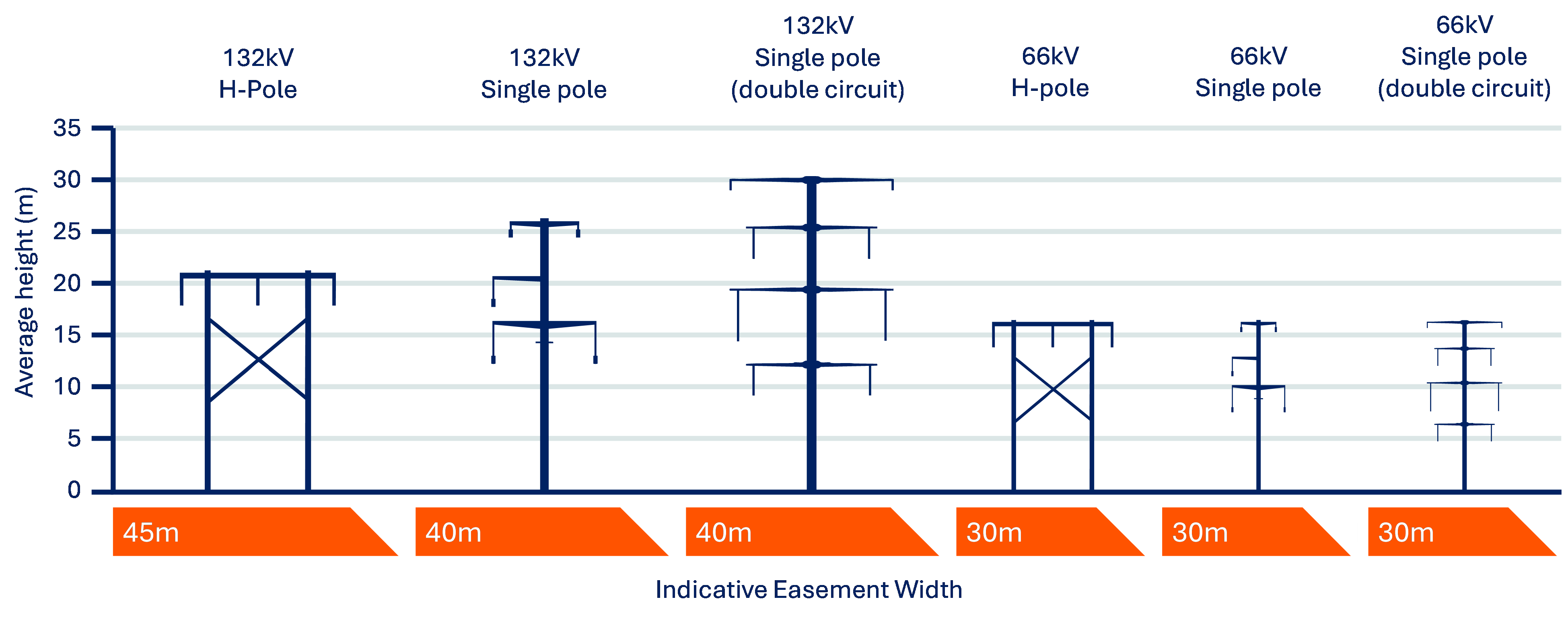
The height of the new poles will depend on the design, and range between 28-34 metres in height - taller than the existing poles in most sections. Information on exact pole sizes will be determined through the surveying, site investigations and then design process and be provided to community through the engagement process.
Typically, the project will utilise the double circuit 132kV structure as indicated in the centre drawing below. In some instances, it will start with a single circuit only (i.e. conductors on one side of the pole only) and will move to a double circuit structure (conductors on both sides) in the future.
Why are these works being undertaken?
The upgrades Essential Energy are undertaking across the Dubbo, Narromine and Gilgandra regions will allow us to connect new renewable energy sources to the network as well as help us keep providing a safe, reliable, and resilient power supply.
The network enhancements will connect generation that supports reliability and power system security, as well as upgrade existing high-voltage infrastructure which is >40 years old in parts. This generation is required to power communities as ageing coal fired power stations retire from the electricity network
The Project will deliver direct benefits to local communities by opening opportunities for new industries and businesses to develop within the region by increasing availability of power on the Essential Energy network while also creating opportunities to export surplus energy to metropolitical areas.
It makes good use of existing infrastructure in Essential Energy’s network to enhance the utilisation of variable renewable energy sources, helping to provide flexible solutions, lower the cost to serve all of Essential Energy’s customers, and improve reliability for electricity consumers across NSW.
In many cases, the network upgrades will involve line re-builds on existing impacted land. Some new easements on private property will be required.
What is Essential Energy's role in the renewables sector?
Essential Energy, as the local electricity network provider, is required under national rules to connect renewable energy projects where it is technically feasible to do so.
This means Essential Energy can assess and provide connection to projects that meet the necessary network and technical requirements. However, it does not decide which renewable projects can proceed.
Decisions about whether a renewable energy project is approved are made by the NSW Department of Planning, Housing and Infrastructure (DPHI), which is responsible for assessing and approving developments across the state.